
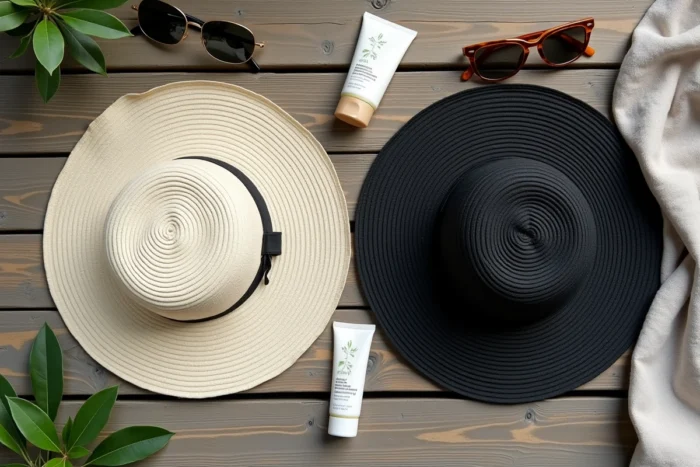
The debate between white hats and black hats resurfaces every summer on forums and in stores. In physics, black absorbs UV while white reflects visible light and part of the ultraviolet radiation. The answer actually depends on the construction of the hat as much as its color: weaving, fabric density, and brim shape weigh just as much as the color.
Weaving and fabric density: the factor that color cannot replace
Before deciding between white and black, one must look at what happens at the fabric level. A loose cotton hat, even if black, allows a significant amount of radiation to pass through the gaps between the fibers. Conversely, a light-colored but tightly woven fabric mechanically blocks UV before color even comes into play.
Fabrics with dense weaving filter more than airy fabrics, regardless of their hue. This is why some light-colored polyester hiking hats have a high UPF rating: their tight weave compensates for the partial reflection of white.
As Tendancez-vous’s advice reminds us, choosing a sun hat is not just about color. The shape, brim width, and material weigh equally in the balance.

Black or white hat against UV: what physics really says
Dark colors absorb a large part of the light spectrum, including UV rays. This is a simple physical fact. A black hat therefore prevents a higher proportion of ultraviolet rays from passing through the fabric to reach the skin.
White, on the other hand, reflects visible light and some UV. This reflection sends rays back outward, but a fraction of the radiation still passes through a loosely woven white fabric. In terms of pure filtration, black has the advantage.
The thermal downside of black
The absorption that makes black effective against UV also produces heat. Under direct sunlight, a black hat accumulates more heat than a white hat. Thermal comfort decreases, especially if the hat lacks ventilation.
The sensation varies depending on conditions: some black hat wearers do not feel discomfort thanks to ventilated models, while others find the heat unbearable after an hour. The feeling depends on the wind, the shape of the hat, and individual tolerance.
Brim width and hat shape: protection for the face, neck, and ears
Color only protects the area it covers. A narrow-brimmed hat, whether white or black, leaves the neck, ears, and part of the face exposed. A wide brim offers better protection than a narrow brim, regardless of color.
A wide-brimmed hat covers often overlooked areas: scalp, ears, nape, forehead. A cap, by comparison, only protects the front of the face. For children, public health sources like Naître et Grandir emphasize wide-brimmed hats that also cover the ears and neck, combined with tightly woven clothing.
- A brim that goes down all around the head (like a bucket hat or sun hat) covers the face, ears, and nape at the same time.
- A cap leaves the nape and ears completely exposed to direct rays.
- A loosely woven straw hat can still let UV through despite a generous brim if the gaps are too wide.
UPF rating: the only reliable benchmark for comparing two hats
The UPF (Ultraviolet Protection Factor) measures the fraction of UV radiation that a fabric allows to pass through. A UPF 50+ fabric blocks nearly all UV. It is the only objective indicator that allows for a fair comparison between a white hat and a black hat.
The problem: not all hats carry this rating. Models sold as fashion accessories have no obligation to display a UPF. Without a UPF indication, color alone guarantees nothing.
How to evaluate a hat without a UPF label
A simple test is to place the hat between your eyes and a light source. If light passes through the fabric, UV does too. This DIY test does not replace laboratory measurement, but it eliminates the most permeable hats.
- If the fabric is opaque to light, the protection is probably adequate.
- If you can see the weave or see bright spots, the weaving is too loose for prolonged exposure.
- Felt hats, thick canvas, or dense technical polyester usually pass this test without difficulty.
Overall strategy: the hat alone is not enough
The effectiveness of a hat is part of a combined strategy: covering clothing with UPF 50+, anti-UV sunglasses, sunscreen, and seeking shade. A hat, even a high-performing one, does not protect the arms, neckline, or legs.
In professional settings, during episodes of intense heat, employers must provide appropriate equipment against solar radiation, which includes hats but also covering clothing and access to shade. The hat is just one piece of the puzzle.
White or black, the final choice depends on your priority. For maximum UV filtration with equivalent fabric, black wins. For better thermal comfort in high heat, white remains more pleasant. In both cases, a wide brim and tight weaving matter more than the hue. Checking the UPF rating when available remains the only way to decide with certainty.