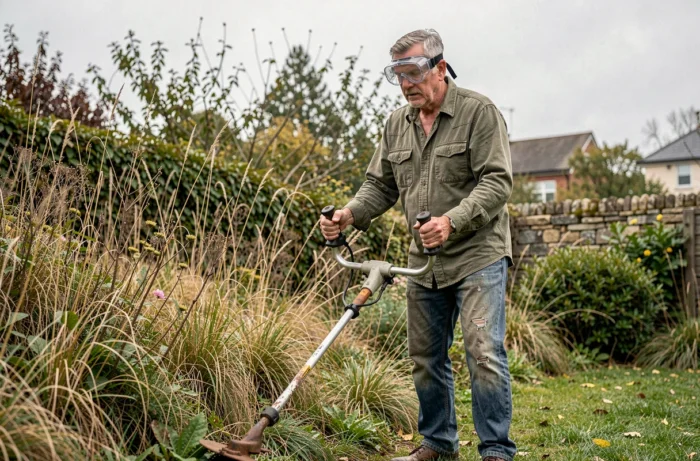
The engine displacement of a thermal engine or the voltage of a battery is not enough to qualify a brush cutter. The choice depends on a combination of parameters that we detail here, starting with the least discussed aspects in general guides.
Sound emergence and noise regulation: a technical selection criterion
The law of April 15, 2024, has included abnormal neighborhood disturbance in the Civil Code. The fixed fine starts at €135 for noise nuisance, with no national decibel threshold set. In practice, it is Articles R.1336-4 to R.1336-11 of the Public Health Code that serve as a reference: the sound emergence must not exceed 5 dB(A) during the day.
Emergence measures the difference between the ambient noise level and the noise level with the device in operation. A thermal brush cutter in a dense residential area crosses this threshold much more easily than a battery model. In the absence of a single national schedule, each municipality sets its own authorized time slots for motorized gardening, often restricted on weekends and holidays.
We recommend checking the municipal order before any purchase. A battery model offers a significantly more comfortable emergence margin and thus widens the usage slots without the risk of fines. This parameter, rarely mentioned in product sheets, weighs as much as raw power in daily operating comfort.
The catalog available at debroussailleuse-warrior.com allows you to compare engines and quickly identify models suitable for use in constrained residential areas.
Motor torque and cutting system: adapting the transmission chain to the vegetation
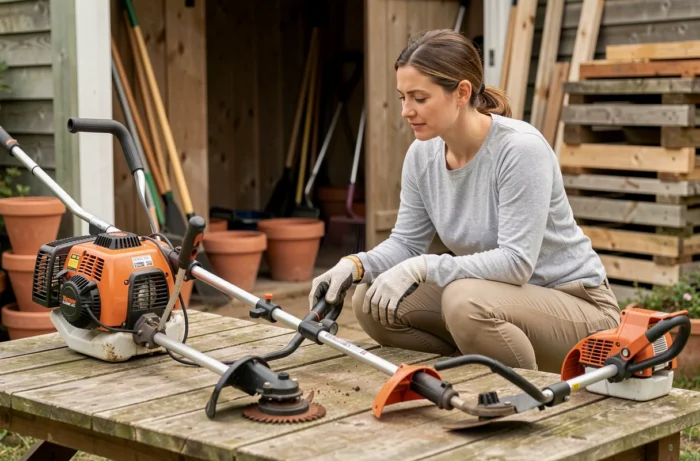
The torque at the angle drive determines the actual cutting capacity, not the power advertised in watts or cubic centimeters. Two machines with the same displacement can deliver very different torque depending on the diameter of the transmission shaft, the angle drive ratio, and the quality of the bearings.
For brambles and woody plants up to a few centimeters in diameter, a three-tooth disc or a shredding blade is necessary. Nylon line, even in square section, does not hold up against semi-woody stems. However, for tall grass and edges, the line remains the most precise and least dangerous system due to ricochet.
Nylon line: section and profile make the difference
A round line glides over soft stems without cutting them cleanly. The square or serrated profile attacks the plant fiber more effectively. The section of the line must correspond to the power of the motor: a line that is too thick on an undersized machine causes jolts and premature wear of the cutting head.
- Thin round line: suitable for edging finishes on short grass, low wear resistance on hard grasses
- Medium section square or star line: versatile, effective on tall grasses and semi-woody weeds
- Toothed disc or shredding blade: reserved for brambles, young shrub regrowth, and dense vegetation that the line cannot cut
We regularly observe users equipped with a disc on a lightweight machine. The result: excessive vibrations, rapid fatigue, and risk of breaking the angle drive. The cutting system should be chosen based on the available torque, not just the vegetation.
Harness and balancing: the factor that the technical sheet does not show
A poorly adjusted harness turns a brush cutting session into a physical trial after twenty minutes. On professional models, the double strap harness with back plate distributes the load across the hips and shoulders. Entry-level models settle for a simple strap, which puts all the weight on a single support point.
The balancing of the machine attached to the harness conditions maneuverability. The attachment point must be positioned so that the cutting head remains parallel to the ground without wrist effort. A few centimeters offset on the tube axis forces constant compensation, generating tension in the forearm and wrist.
Handlebar or loop handle: not just a matter of preference
The handlebar (bike type) is suitable for open terrains where the mowing movement is wide and regular. The loop handle, in the shape of a D, offers better agility in cluttered areas (tree feet, flower beds, fences). Choosing one or the other based on the dominant terrain avoids a compromise that satisfies no use.

Thermal or battery brush cutter: deciding based on surface area and frequency
The question is not posed in terms of the superiority of one motorization over the other. It is decided based on three concrete parameters:
- Area to be treated per session: beyond several hundred square meters of dense vegetation, the autonomy of a standard battery limits continuous work, unless investing in a second battery
- Frequency of use: regular weekly use favors the battery (no fuel to store, instant start); intensive seasonal use on a large plot leans towards thermal
- Neighboring constraints: as detailed above, the battery reduces sound emergence and regulatory risk
The thermal model retains an advantage in prolonged autonomy and low-speed torque for heavy work. The battery is rapidly progressing in power, but the cost of a high-capacity battery pack remains significant. We recommend comparing the total cost over five years (fuel, spark plug and filter maintenance, battery replacement) rather than just the purchase price.
The choice of a brush cutter hinges on details that the product sheet does not highlight: actual torque at the angle drive, compatibility of line/disc with power, quality of the harness, and now compliance with local noise constraints. Taking the time to cross-reference these parameters with the reality of your terrain remains the most reliable method to avoid a disappointing purchase.