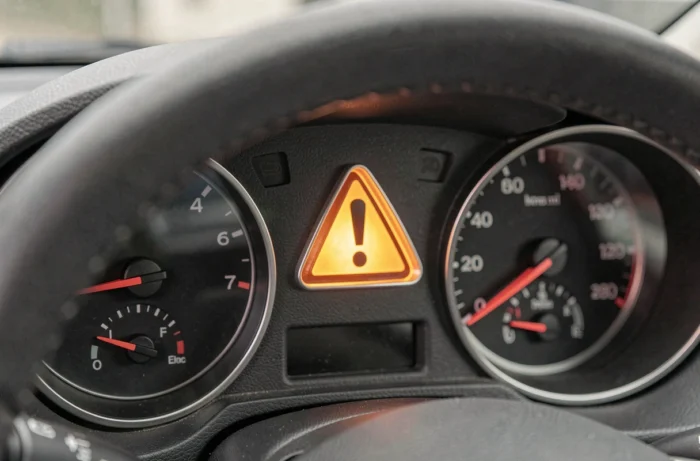
The triangle-shaped warning light with an exclamation point indicates a general alert from the vehicle’s electronic system. It does not point to a specific component but indicates that a message or anomaly requires your attention on the dashboard computer. Its color, orange or red, determines the degree of urgency and the action to take.
General alert or targeted failure: what the triangle doesn’t say alone
Unlike the engine oil light or the coolant temperature light, the triangle with an exclamation point does not designate a single component. It functions as an information relay: the computer detects a deviation from normal parameters, and in the absence of a dedicated pictogram, it activates this generic light.
The list of possible causes is broad. A tire pressure sensor detecting a deviation, a low brake fluid level, a malfunction of the ESP, a burnt-out bulb, or a problem with the braking system can all trigger the same symbol. Hence the importance of immediately checking the message displayed on the multifunction screen when the vehicle is equipped with one.
To delve deeper into the meaning of the triangle sign with an exclamation point, it is necessary to distinguish between two situations: the light that briefly illuminates at startup (normal self-test) and the one that stays on or appears while driving (actual anomaly).

Orange or red triangle light: the color changes everything
The color of the light is not decorative. It follows a standardized code set by car manufacturers, common to almost all brands.
Orange triangle: caution without immediate urgency
An orange triangle indicates a non-critical anomaly. Driving remains possible over a short distance, provided you drive carefully. Among the frequent triggers:
- An abnormal tire pressure detected by TPMS sensors, often after a change in temperature or insufficient inflation.
- A partial malfunction of driving assistance (traction control, adaptive cruise control) that switches to degraded mode.
- A low windshield washer fluid level or a scheduled maintenance reminder, depending on the brand.
In these cases, the vehicle operates normally, but the problem should be identified in the following days to prevent it from worsening.
Red triangle: quick stop recommended
A red triangle requires stopping as soon as possible in a safe manner. It usually accompanies a fault in the braking circuit, engine overheating, or a critical drop in oil level. Continuing to drive under these conditions exposes you to the risk of mechanical failure or loss of control.
If the red light is accompanied by a beeping sound or an explicit message (“braking fault,” “engine temperature”), the priority is to turn off the ignition after a safe stop and have the vehicle towed to a workshop.
Mandatory driving assistance systems and new alerts
Since July 7, 2024, the European GSR2 regulation mandates a set of mandatory assistance systems on all new cars registered in the EU. Among them are Intelligent Speed Assistance (ISA), driver drowsiness detection, and an emergency braking signal that can trigger a light or alert message when the vehicle brakes sharply.
In practice, the triangle with an exclamation point now appears in situations unrelated to mechanical failure. A prolonged distraction detected by the attention monitoring system, exceeding the speed limit indicated by the ISA, or obstacle detection while reversing can activate this same generic light.
By July 7, 2026, these requirements will be further strengthened with the obligation of camera-based attention monitoring (ADDW) and more advanced emergency braking systems for all new vehicles and utility vehicles. Therefore, the triangle with an exclamation point is likely to illuminate more frequently on newer models, without any mechanical component being involved.

Concrete diagnosis: what to check before going to the garage
Before making an appointment with a mechanic, a few quick checks can sometimes resolve the issue or at least pinpoint its origin.
- Read the message on the dashboard computer. Most vehicles produced after 2010 display a text or code associated with the triangle light. This text guides the diagnosis.
- Visually check the levels of accessible fluids: engine oil, brake fluid, coolant. A visible shortage often explains the alert.
- Check the pressure of all four tires (including the spare tire if the vehicle has one). An under-inflated tire triggers the TPMS sensor on many models.
- Turn off the ignition, wait about ten seconds, then restart. A temporary bug in the computer can cause a false positive that disappears after a reset.
If the light persists after these checks, or if it is red, a visit to the workshop with a diagnostic scan remains the only reliable method to identify the exact fault code recorded by the computer.
Differences by manufacturer
The pictogram varies slightly from one brand to another. At some German manufacturers, the triangle may be accompanied by an arrow indicating a direction, which refers to a problem with the power steering or stability system. At others, the same symbol without an arrow points to a maintenance reminder or a minor fault in the onboard electronics.
The owner’s manual remains the reference for identifying the exact variant used by your vehicle. Its “lights and alerts” section associates each pictogram with a list of possible causes specific to the model.
The triangle with an exclamation point has become the “catch-all” light on the modern dashboard. With the proliferation of sensors and mandatory driving aids, it activates for an increasingly varied set of reasons. Reading the associated message, checking basic levels, and distinguishing between orange and red colors: these three reflexes are enough to determine whether the situation requires an immediate stop or a trip to the garage.