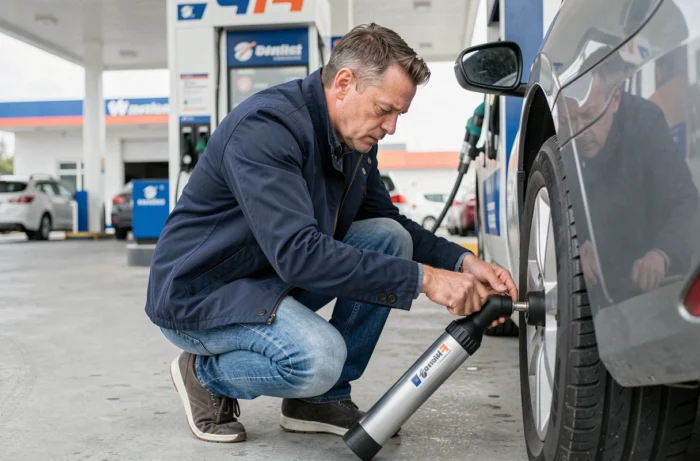
A tire inflator, whether at a gas station or in the form of a standalone kiosk, allows you to adjust the pressure of your tires to the value recommended by the manufacturer. This service, which was once systematically included when refueling, has become paid in the majority of French stations. However, several alternatives allow you to benefit from it without spending a dime, provided you know where to look.
Advertising-funded inflation kiosks: a growing model
The classic reflex is to look for a gas station equipped with a free kiosk. The reality on the ground is different: most kiosks at stations now charge for inflation, often between one and two euros.
An alternative model has recently developed. Players like Gonflib are deploying fully free automatic inflation kiosks for users. Their funding relies on a digital display screen integrated into the kiosk, which broadcasts advertisements. The motorist inflates their tires, and the advertiser funds the service.
These kiosks are installed in shopping center parking lots, public sites, or partner gas stations. Their particularity: no purchase condition is required. You just need to park nearby and connect the hose to the valve. To get a free tire inflator of this type, you need to locate the spots via the operator’s website or collaborative mapping applications.
This system transforms the inflation kiosk into an attractive element for the parking lot that hosts it, which explains the increase in installations in recent months.

Free inflation at auto centers: what Norauto, Feu Vert, and others offer
Automotive center brands like Norauto or Feu Vert often provide free-access inflation kiosks in their parking lots. Inflation is generally free and accessible without an appointment, even without making a purchase or workshop service.
Several points should be checked before going there:
- The kiosk is sometimes located outside the building, accessible outside the store’s opening hours, but not always. Some centers place it in the workshop area, which requires visiting during service hours.
- The integrated pressure gauge on the kiosk displays pressure in bar. The target value can be found on the label attached to the driver’s door frame or in the vehicle manual.
- These kiosks accept standard valves (Schrader), which are present on almost all cars. For a bike equipped with a Presta valve, an adapter is necessary.
Going to an auto center for inflation alone remains the most reliable solution in urban and suburban areas. The density of these brands across the territory makes the service accessible to the majority of motorists.
Highway rest areas with continuous inflation access
On the highway, the situation is less predictable. Some rest areas have inflation kiosks listed among the continuously available facilities, regardless of the store or restaurant hours. Recent reports from highway stations (for example, Fulli on the A20 or Avia on the A81) confirm this trend towards permanently accessible self-service inflation.
Free service is not guaranteed at all rest areas. Some kiosks operate with a coin mechanism or a payment terminal. Before a long trip, checking the pressure at a free auto center remains safer than relying on a highway kiosk whose cost and operational status are uncertain.
Personal portable inflator: a one-time investment against repeated expenses
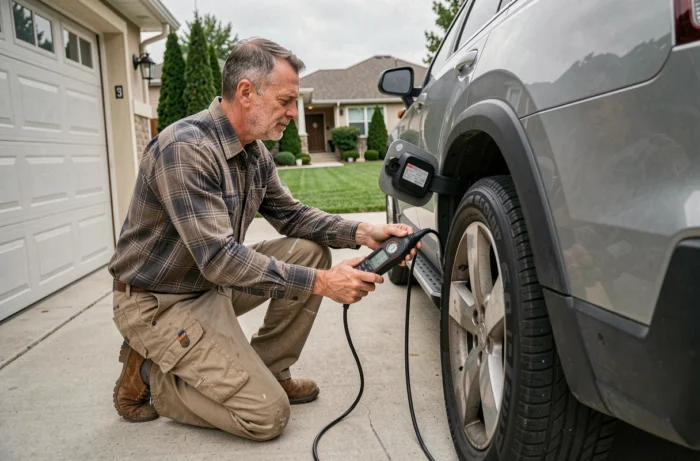
Owning your own portable electric inflator eliminates the question of locating a kiosk. These devices, powered by a rechargeable battery, connect to the tire valve and inflate to the pressure set on a small digital screen.
A decent quality portable inflator costs between a few dozen euros for a basic model and more for a device with a precise gauge and good battery life. The investment pays off quickly if paid inflation at a station was a regular expense.
The criteria to examine before purchase:
- The maximum pressure delivered, expressed in bar. For a car, sufficient inflation capacity is around the pressure recommended by the manufacturer, usually between two and three bar depending on the vehicle and tire.
- The type of compatible valve. Versatile models include adapters for Schrader (car) and Presta (bike) valves.
- The battery life. An inflator capable of reinflating all four tires of a car on a single charge avoids unpleasant surprises on the roadside.
- The presence of a reliable integrated gauge, which allows stopping inflation at the exact value without overcorrecting.
Tire pressure: when and why to check for free
Pressure should be checked on cold tires, meaning after less than three kilometers of driving or after at least two hours of stopping. A hot tire shows an artificially high pressure, which skews the reading on the gauge.
Under-inflation increases fuel consumption and accelerates the wear of the tire’s sidewalls. Over-inflation reduces the contact surface with the road and degrades grip, especially on wet pavement.
The frequency recommended by most manufacturers is around a monthly check. Before a vacation departure with a loaded vehicle, adjusting the pressure to the load (the “full load” value indicated on the manufacturer’s label) is part of the often-neglected road safety reflexes.
Free inflation, whether through an advertising kiosk, an auto center with free access, or a personal portable inflator, is only valuable if it is accompanied by a correct reading of the target pressure. Checking this value on the door frame label before each operation remains the most useful gesture, and it costs nothing.