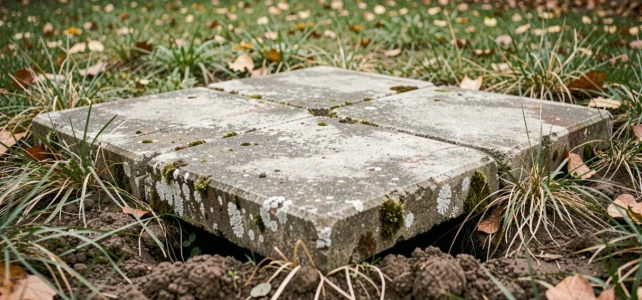
When you open a concrete tank at the back of the garden and come across a dark tank with crusty deposits on the walls, the first question is rarely theoretical. You want to know if the system still holds, whether everything needs to be torn out, or if you can buy some time before heavy work is required. Old concrete septic tanks pose this kind of concrete dilemma, especially when no plans accompany the house.
Corrosion of concrete by H2S: the real weak point of old tanks
The problem that no one sees from the surface is the internal chemical degradation. Stagnant wastewater produces hydrogen sulfide (H2S), a gas that attacks the concrete from the inside. On a tank installed several decades ago, this corrosion has had time to erode the wall, sometimes making it porous.
You can spot the phenomenon by scraping the internal surface during a pumping: if the concrete crumbles like sand, the tank has lost its watertightness. Infiltration of groundwater into the tank (or vice versa, leaks into the ground) is then almost certain. A tank corroded by H2S cannot be repaired durably, even with a sealing coating.
To fully understand the operation of an old concrete septic tank, it is important to keep in mind that sedimentation only works properly if the tank remains watertight. As soon as the concrete is compromised, the sludge no longer settles normally, and the pretreatment becomes ineffective.
Sedimentation and anaerobic fermentation: what really happens in the tank
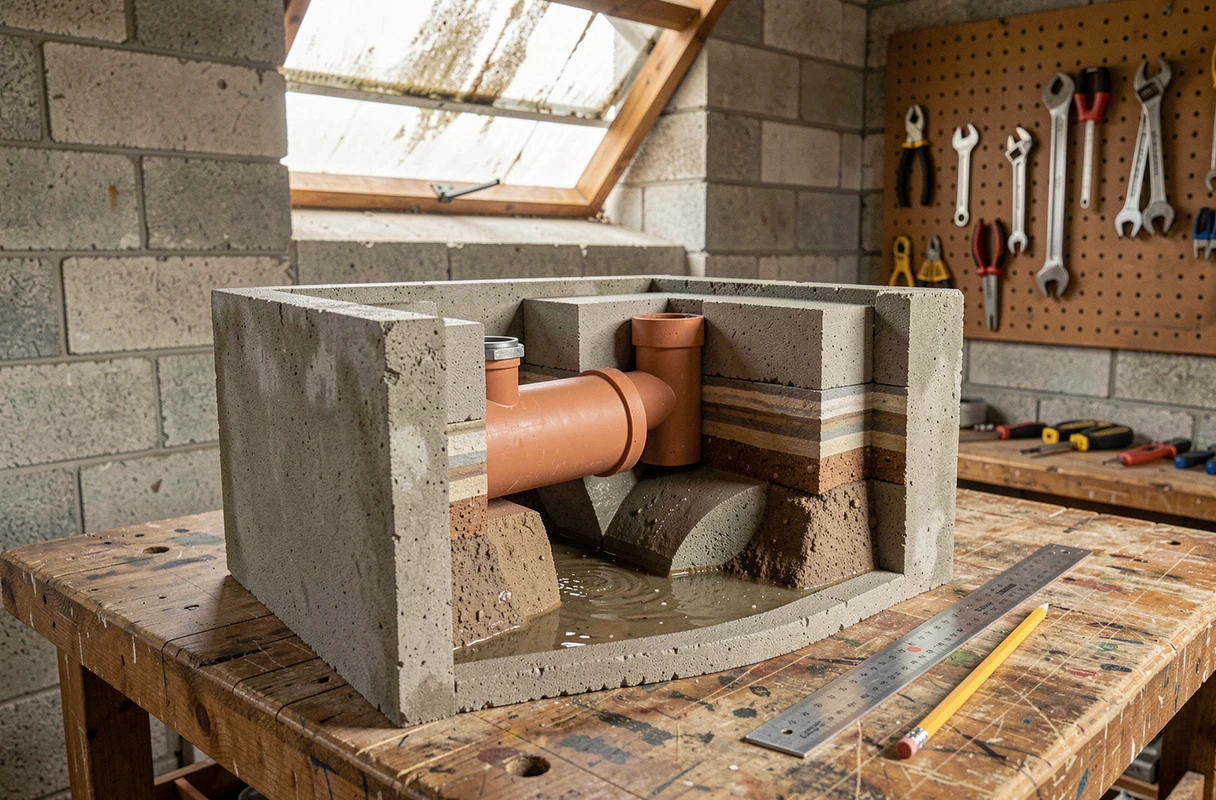
The principle is mechanical before it is biological. Wastewater arrives through the inlet pipe, and its speed drops sharply in the tank’s volume. Heavy materials settle at the bottom to form sludge. Fats and lighter materials rise to the surface and create a floating crust.
Between these two layers, the intermediate liquid zone is what is evacuated to the downstream treatment system. It is in this clarified (but untreated) water that the utility of the tank lies: separating solids from liquids before spreading or filtering.
Role of anaerobic bacteria in sludge digestion
The bacteria that work in a septic tank do not need oxygen. They slowly digest the organic matter accumulated at the bottom, which reduces the volume of sludge over time. This anaerobic fermentation process produces gas (methane, H2S), hence the need for proper ventilation.
In old installations, ventilation often consists of a simple vent pipe on the roof, sometimes blocked or absent. Without ventilation, gases accumulate and accelerate the corrosion of the concrete while generating odors at the surface.
Septic tank or all-water tank: a confusion that changes everything
An old septic tank in the strict sense only received wastewater (toilets). Household wastewater (kitchen, shower, sink) went directly into a soakaway or ditch, without any treatment. This type of installation has not been allowed for new constructions since 2009.
The all-water tank, on the other hand, collects all domestic wastewater. When diagnosing an old installation, the first thing to check is precisely this point:
- If only the toilets are connected to the tank, we are dealing with an old septic tank, non-compliant with current sanitation standards
- If all wastewater arrives in the tank but it has not been sized for this volume, the sludge rises too quickly and the effluent exits overloaded
- If a grease trap exists upstream for kitchen wastewater, it is often a sign of an installation that has been partially adapted at some point
Feedback varies on this point, but in the majority of cases encountered in the field, old concrete tanks only treat wastewater.
Pumping and maintenance of an old concrete tank: the concrete thresholds
Pumping becomes necessary when the sludge reaches half of the tank’s usable volume. In an old installation that is rarely used (such as a secondary residence), it can last several years. In a house occupied full-time, the interval is around a few years between two interventions.
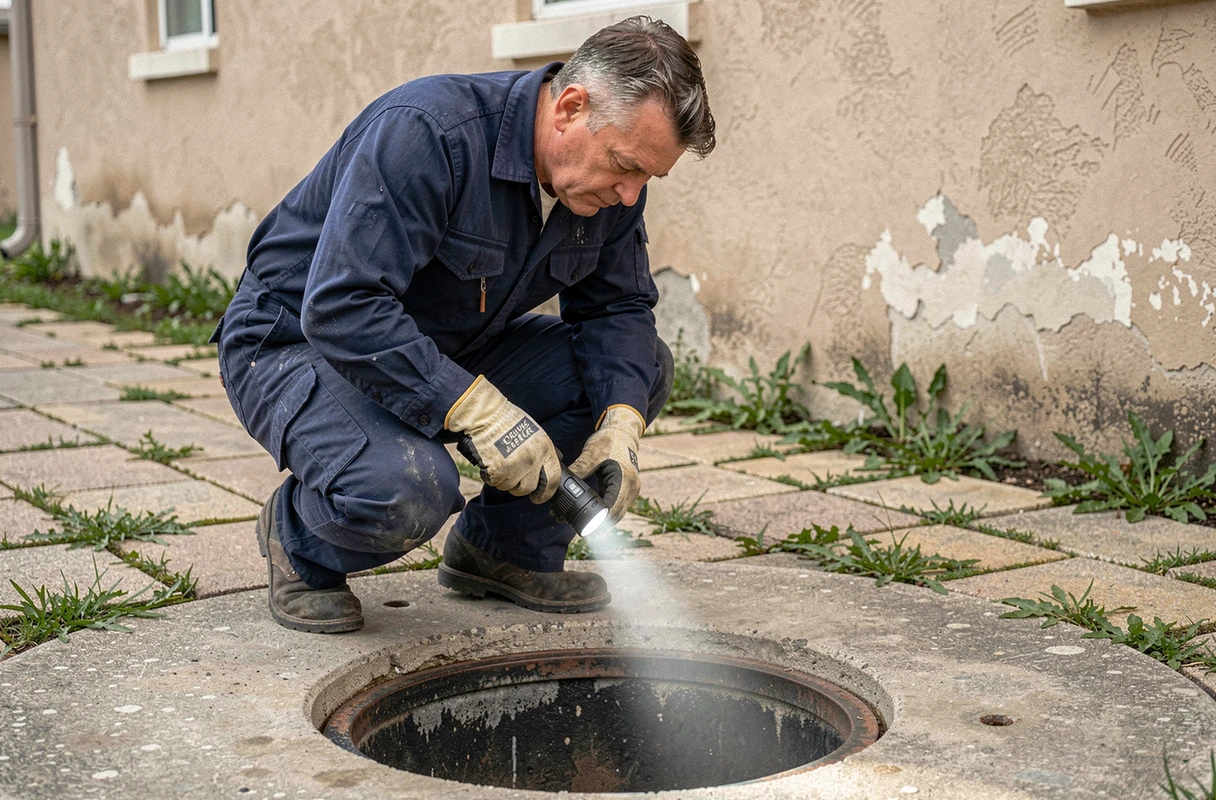
During pumping, the professional can visually inspect the condition of the concrete, check the internal partitions (some tanks have two compartments), and control the inlet and outlet pipes. This is the ideal time to assess what remains usable.
What to check first on an old installation
- The condition of the internal concrete: crumbling walls, visible cracks, signs of infiltration
- The presence and proper functioning of ventilation (unobstructed roof vent)
- The actual connection of all wastewater or only toilets
- The existence of downstream treatment (spreading, sand filter, drain) and its apparent condition
The tank alone does not constitute complete sanitation. It only ensures pretreatment through sedimentation. Without a downstream treatment device (underground spreading, sand filter, or compact system), the discharged effluents remain heavily polluted.
Neutralization of a decommissioned tank: the procedure to follow
If the old concrete tank is no longer connected to the network (after a connection to the sewer system, for example), it cannot simply be left in place underground. It must be completely pumped out, disconnected, and taken out of service before any backfilling.
Concretely, this means calling in a licensed pumper, then either filling the tank with sand or gravel to prevent collapse, or having it removed if excavation work is planned. A simple backfilling without prior pumping creates a lasting health and structural risk.
The SPANC (Public Service of Non-Collective Sanitation) checks the compliance of installations during periodic diagnostics or at the time of a real estate sale. In case of non-compliance found, the buyer has a deadline to bring it up to standard, which often includes the outright replacement of the old septic tank with an all-water tank or a micro-treatment plant.
A concrete tank that has lasted several decades is not a problem in itself. The real risk is believing it to be functional without having checked either its watertightness or what happens downstream.