
The word hentai refers, in Japanese, to a transformation or a deviation. An abbreviation of hentai seiyoku (sexual perversion), the term has shifted to a completely different usage in the West: it qualifies manga and anime with pornographic content. This semantic gap between Japan and the rest of the world constitutes the first misunderstanding to clear up for anyone interested in the genre.
Hentai manga and artificial intelligence: a turning point for production
The arrival of artificial intelligence image generators has significantly altered the production chain of hentai. Simplified interfaces, coupled with pre-trained models on manga aesthetics, allow for the creation of custom pages or illustrations without the need for a drawer. This industrialization of hentai by AI raises unprecedented questions about intellectual property and artist compensation.
Specialized platforms offer fine customization tools for bodies and scenarios. The result, often difficult to distinguish from human production, floods sharing sites. For mangakas who make a living from hentai in Japan, the competition from these nearly cost-free generated contents poses a direct threat to their income.
Those looking to understand hentai manga in its current dimension cannot ignore this technological mutation, which redistributes the cards among creators, publishers, and consumers.

Regulation in France: hentai caught in the net of content control
The legal framework in France surrounding online sexual content is tightening, and hentai is not exempt. A recent Senate report includes sexualized and sexist content within the scope of systemic risks defined by the European Digital Services Act. Among the proposals: legally prohibiting access to social networks for those under 15 and strengthening the role of Arcom in reporting mechanisms.
This regulatory movement does not specifically target hentai. It encompasses all pornographic content accessible online, whether filmed or drawn. However, the specificity of hentai, which sometimes features characters with juvenile appearances, places it in a zone of legal friction more intense than traditional pornography.
Age verification and site blocking
Arcom has recently been granted expanded powers to require the implementation of age verification systems on pornographic sites. Platforms hosting hentai, often based outside of France, find themselves in the crosshairs. DNS blocking remains the primary tool, but its actual effectiveness is debated: a VPN is enough to bypass it.
Publishers of printed hentai manga, on the other hand, escape these digital constraints. The books are sold shrink-wrapped in bookstores, with an age label. This distinction between physical and digital media creates a asymmetrical treatment of the same content depending on its distribution channel.
From printed manga to virtual reality: the new formats of hentai
Hentai has long been associated with two formats: printed manga and anime (OVA or series). That era is over. The genre has diversified into formats that articles focused on Japan’s cultural history rarely mention:
- Virtual reality games, where hentai now appears in the recommendation lists of specialized VR porn sites, alongside filmed productions
- Interactive visual novels on PC and mobile, which combine narration, narrative choices, and explicit drawn sequences
- The AI image generators mentioned earlier, which blur the line between passive consumption and participatory creation
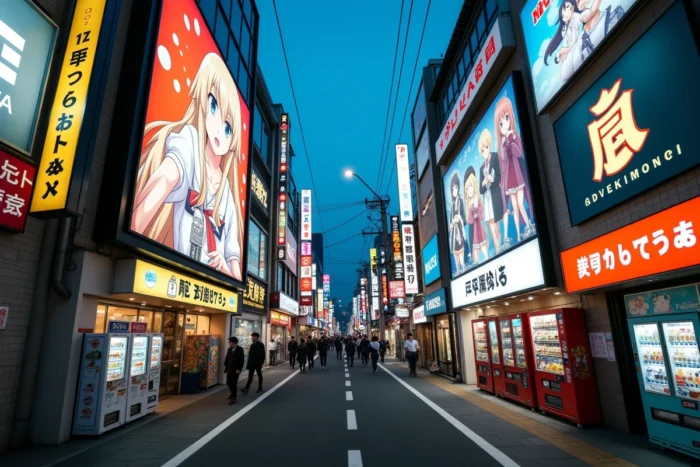
This shift from a niche genre to a product integrated into the adult entertainment economy marks a break with the image of hentai confined to otaku conventions and specialized shops in Tokyo or Akihabara.
Hentai VR: an expanding niche
The presence of hentai in adult VR game catalogs illustrates a change in status. The genre is no longer a confidential by-product: it appears in buying guides, headset comparisons, and content rankings. The graphic quality of some productions rivals that of traditional animation studios.
Hentai in Japan and the West: two readings of the same word
In Japan, calling someone hentai essentially amounts to labeling them as perverse. The term has no direct link to manga. To refer to erotic or pornographic comics, the Japanese use other categories: seinen adult, ero-manga, or dōjinshi with explicit content. The classification is based on the target audience (male, female, orientation) rather than a single label.
In the West, hentai functions as a catch-all term that encompasses all drawn sexual content of Japanese inspiration. This simplification erases cultural distinctions that the Japanese market maintains rigorously. An ero-manga aimed at a female readership (josei) has nothing in common, either in tone or staging, with a dōjinshi produced for a male audience at Tokyo’s Comiket.
The available data does not allow for precise quantification of the size of the hentai market, whether printed or digital. Japanese publishers do not publish isolated figures for this category, and online platforms do not disclose their traffic volumes by genre.
Understanding hentai manga benefits from going beyond mere curiosity or rejection. Between technological mutation, regulatory pressure, and expansion into new formats, the genre is undergoing a transformation that redefines its production, distribution, and perception in both Japanese society and Europe.