
Ordering a serum or foundation without testing it is to accept a gamble on texture, shade, and compatibility with one’s skin. You receive the package, open it, and sometimes the disappointment is immediate: the nude leans gray, the cream smells like plastic, the bottle doesn’t match the photo.
Online beauty shopping has surged in recent years, but buying mistakes remain common, especially when navigating between marketplaces, brand sites, and social media that have become shopping showcases.
Online beauty products: where you buy changes what you receive
We often think that the product will be the same regardless of the channel. In practice, the choice of platform influences the price, stock freshness, and after-sales service. According to NielsenIQ, Amazon is the leading online beauty seller in most major European markets, and a significant portion of its customers no longer buy their cosmetics anywhere else.
This platform exclusivity behavior has a concrete effect: we compare less, check expiration dates less, and miss out on references available only on specialized sites or stores like Sephora or Beauty Success. To diversify sources without wasting time, one can use shopping on Beauty Girl, which aggregates targeted categories by product type.
Reviews vary on this point, but some generalist marketplaces host third-party sellers whose stock authenticity is not always guaranteed. Buying a perfume or face care on an official brand site or a recognized store limits this risk.
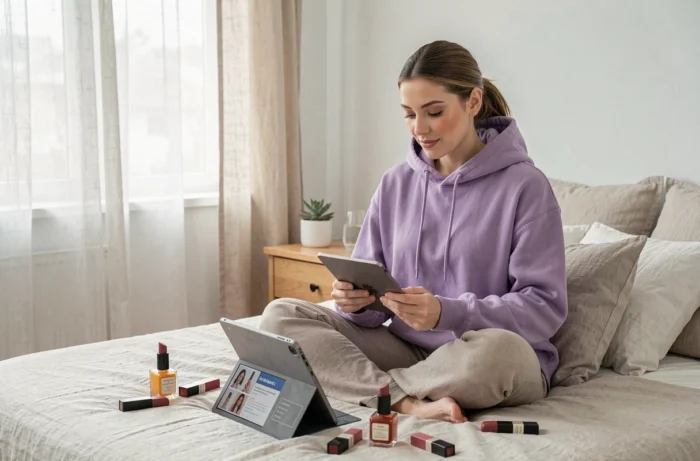
Choosing a makeup shade without testing: a concrete method
Foundation remains the most returned product in beauty e-commerce. The reason is simple: screens distort colors, and shade names (“golden sand,” “rosy ivory”) describe nothing precise.
Three checks before confirming your cart
- Look for video swatches on bare skin, filmed in natural light, rather than the retouched photos from the shopping site. TikTok and YouTube are full of demonstrations by users with varied skin tones.
- Compare the desired shade with a product you already own using equivalence charts between brands, available on several specialized blogs.
- Order a sample or travel size when the site offers it. Spending a few euros on a tester avoids a twenty-euro return fee.
For lip products and eye makeup, sticking to a brand whose formulation you already know remains the most reliable strategy. Switching ranges online without prior testing increases the chances of disappointment.
Social commerce and live shopping: buying on TikTok without getting trapped
NielsenIQ indicates that more than half of consumers have already purchased via a social platform. Live shopping, in particular, encourages quick decisions: the product is shown live, a promo code expires in ten minutes, and you click before thinking.
The most common trap is not a scam, but the impulsive purchase of an unsuitable product. A spectacular highlighter under ring light can yield a very different result in everyday life. Before confirming an order via TikTok Shop or Instagram, apply a simple rule: wait 24 hours before finalizing any unplanned purchase.
Social commerce works well for discovering emerging brands, especially in K-beauty, whose sales have significantly increased thanks to social media in recent months. However, for regular-use skin care (moisturizers, anti-aging serums), it’s better to check the INCI list on the brand’s site rather than relying on a thirty-second demonstration.
Sales and online beauty promotions: spotting real price drops
Sale periods generate a surge of promotions on face care, perfumes, and makeup. The problem: some sites inflate the reference price a few weeks before the promotion to display a flattering discount.
Outsmarting false discounts
Installing a browser extension that tracks price history (Keepa for Amazon, or equivalent tools for other sites) allows you to verify if the discount is real. It is often found that a “40% off” set costs the same as it did a month earlier.
For hair products and body care, the XXL formats highlighted during Black Friday or private sales are not always advantageous per liter. Pulling out the calculator remains the most reliable method, even if it breaks the magic of compulsive clicking.
- Always compare the price per milliliter or gram, not the face value of the product.
- Check the expiration date on promotional lots and sets, which sometimes sell off old stock.
- Prefer online stores that clearly display their return policy for opened beauty products.
Return policy and customer experience: what makes the difference
A site that offers free shipping but charges eight euros for returns is not a good deal if the product doesn’t fit. On skin care and makeup, the return policy conditions the quality of the shopping experience as much as the product itself.
Some brands accept returns of opened products under certain conditions (less than a third used, for example). Others refuse any return once the seal is broken. Reading the terms and conditions before placing an order, and not after receiving the package, avoids unpleasant surprises.
Online beauty in 2024 will play out on three fronts: choosing the right purchasing channel, concretely verifying shades and formulas before ordering, and the ability to resist promotional mechanics designed to speed up decision-making. A thoughtful cart, even if smaller, yields better results than an impulsive spree during a flash sale.