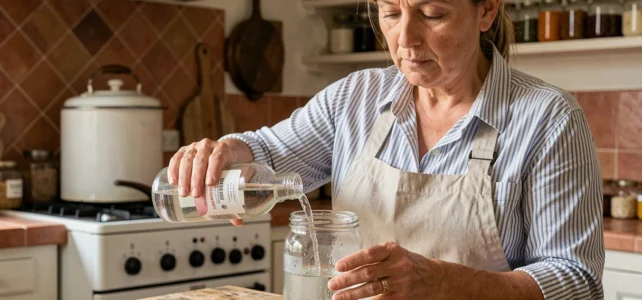
You have harvested cherries from the garden, plums, or mirabelles, and you want to preserve them in jars for the winter. The 90° alcohol for fruits sold at Leclerc seems to be the most straightforward solution. However, between the bottle in the cleaning aisle and that in the spirits aisle, mistakes are common, and they can make your jars unsafe to consume.
Food-grade 90° alcohol at Leclerc: the right aisle and the right label
The first instinct, often the wrong one, is to look for 90° alcohol in the drugstore or cleaning aisle. The product found there is a household alcohol, sometimes denatured with additives that make it unsuitable for ingestion. The degree displayed on the bottle does not guarantee anything regarding food use.
The product suitable for fruit jars is found in the spirits aisle, next to vodkas and brandies. On the label, look for the explicit mention “alcohol for fruits,” “fruit maceration,” or “liqueur preparation.” It is this mention, and not the degree alone, that confirms the product is intended for food use.
Several Leclerc hypermarkets have gradually reduced their offer of 90° neutral alcohol in self-service, replacing this reference with ready-to-consume spirits or lower-proof alcohols. If your store no longer offers the product, you can use the 90° alcohol for fruits from Leclerc by checking availability via the drive or asking the staff in the wine and spirits section.
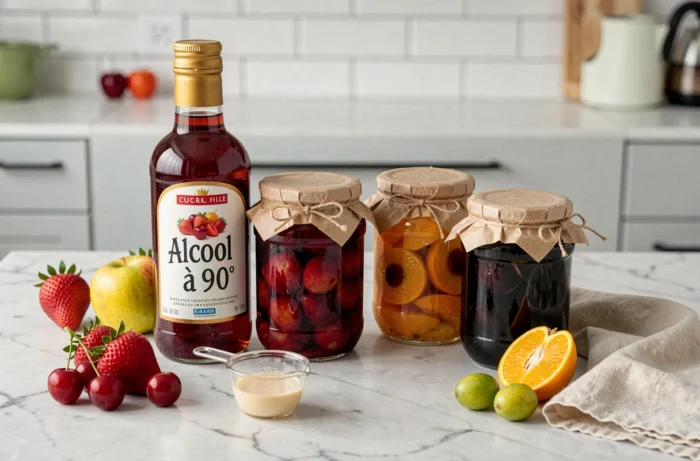
Alcohol degree and jar preservation: what the proof really changes
Why choose 90° alcohol over 40° vodka or white rum? The answer lies in extraction and preservation capacity.
A 90° alcohol extracts the flavors from the fruits more quickly and completely than a 40° alcohol. It partially dehydrates the fruits, which slows the development of microorganisms. The result is a jar that preserves much longer, with more concentrated flavors.
An alcohol with at least 40° can be sufficient for proper preservation, provided you adhere to strict hygiene rules and store the jars away from heat and light. The difference lies in duration: a jar prepared with 90° remains stable for years, while a jar at 40° is consumed within months.
Maceration and preservation: two distinct logics
Macerating fruits in alcohol to obtain a liqueur is not the same as preserving whole fruits in a jar. Maceration aims for flavor extraction into the liquid. Preservation aims for the stability of the fruit itself in its container.
For a liqueur, you filter and discard the fruits after a few weeks. For a preservation jar, the fruits remain submerged and must retain their texture. The alcohol degree and the amount of added sugar determine which of these two results you achieve.
Sterilizing jars before filling: alcohol alone is not enough
You may have heard that 90° alcohol “disinfects everything.” In practice, alcohol does not replace the prior sterilization of the jar. Recent preservation guides emphasize this point: even with strong alcohol, jars and lids must be sterilized in boiling water before filling.
Here are the steps to follow before pouring in the alcohol and fruits:
- Wash the jars and lids in hot soapy water, then rinse thoroughly.
- Submerge jars, lids, and seals in a pot of boiling water for about ten minutes.
- Place them upside down on a clean towel and let them dry without wiping with a cloth.
- Fill the jars while they are still warm to limit thermal shock.
This step eliminates bacteria that alcohol alone might not necessarily destroy, particularly resistant spores. Skipping this precaution exposes you to unwanted fermentation, or even a risk of botulism in the most severe cases.
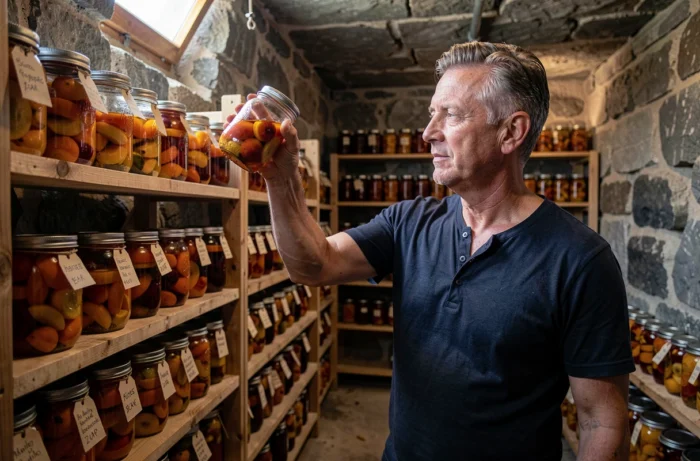
Fruits suitable for preservation in 90° alcohol
Not all fruits react the same way to a strong alcohol bath. Firm-fleshed fruits with thick skins hold up better over time.
- Cherries, plums, mirabelles, and quetsches are the most classic. Their skin withstands alcohol, and their flesh does not break down.
- Peaches and apricots work, but they need to be halved and pitted. Their softer flesh becomes mushier.
- Citrus fruits (only zest) are more suitable for flavoring a liqueur than for being preserved whole.
- Strawberries and raspberries break down quickly. They are suitable for a short maceration to obtain a syrup or liqueur, not for long-term preservation in a jar.
Prick thick-skinned fruits with a needle before immersing them in alcohol. This operation allows the liquid to penetrate the flesh evenly and speeds up the infusion.
The role of sugar in the jar
Sugar is not just there to sweeten the taste. It acts as a co-preservative by lowering the water activity in the jar, making the environment even less favorable to bacteria. The proportions vary depending on the fruits, but the principle remains the same: a layer of fruits, a layer of sugar, then the alcohol poured to cover everything.
Storage and shelf life of jars in alcohol
A properly prepared jar with food-grade 90° alcohol, healthy fruits, and a sterilized jar can last several years. Two conditions are crucial: darkness and a stable, cool temperature.
A cellar, pantry, or cupboard away from a heat source is suitable. Avoid an uninsulated garage, where temperature fluctuations between summer and winter can alter the contents. Check the seal of the lid after a few days: if any liquid seeps out or if the seal seems misaligned, open, clean, and reseal.
The resting time before consumption is often underestimated. Allow at least two months for the flavors to develop and the alcohol to mellow. The best results are achieved after six months or more. A jar opened too early will have a burning taste and little aromatic complexity.