
Creating your own clothing collection involves coordinating creative work, technical constraints, and a regulatory framework. The process ranges from brand positioning to sales, including textile sourcing, pattern making, and legal compliance. Here are ten practical tips to structure each step of this creation.
1. Write a textile specifications document before designing

The textile specifications document sets the technical parameters for each piece: type of fiber, weight, desired drape, wash resistance. Without this document, exchanges with fabric suppliers and production workshops lack precision, leading to costly back-and-forth on prototypes.
Each model in the collection deserves its own sheet. It specifies the desired composition, finishes (topstitching, bias, closures), colors, and color tolerance. This document becomes the reference for comparing offers from multiple suppliers and making decisions between cost, quality, and production time.
Several creators share online tips for creating a clothing collection that detail the structuring of this type of technical document, from the choice of raw materials to sample validation.
2. Define a measurable brand positioning

A brand positioning is not just a mood board. It translates into verifiable criteria: target price range, main sales channel (online store, multi-brand, direct sales), production volume per season, and customer profile (age, budget, shopping habits).
Writing these criteria helps filter creative decisions. If the positioning targets mid-range ready-to-wear sold online, a material with a unit cost exceeding half of the final selling price is eliminated from the start. This framing avoids overly broad collections that dilute the brand’s identity and complicate inventory management.
3. Work with a pattern maker from the first prototype

The pattern maker translates a sketch into an industrially viable pattern. Entrusting this step to a professional from the first prototype reduces the number of fittings and corrections. A poorly constructed pattern affects the entire production chain: misaligned cuts, excessive fabric consumption, sizing issues.
Before sending a model to the pattern maker, the technical file must include reference measurements, annotated sketches (front, back, side), and finishing details. The more complete this file is, the less the prototype needs adjustments.
4. Plan the collection by categories of pieces
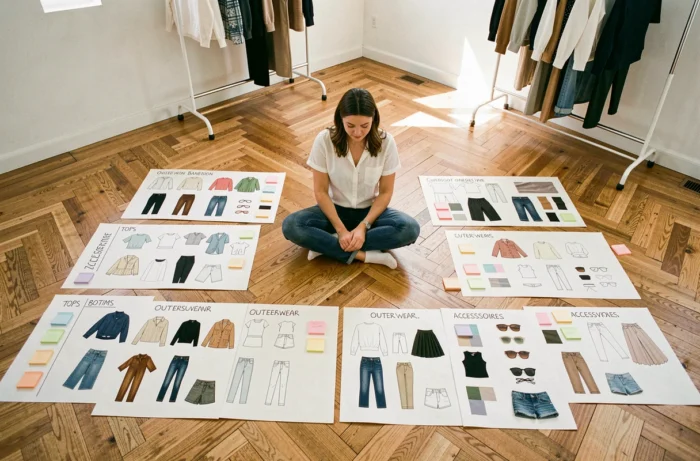
A collection plan organizes the models by categories: tops, bottoms, dresses, jackets, accessories. It sets the number of references per category, color variations, and available sizes. This dashboard allows for anticipating raw material volumes and estimating production costs before launching manufacturing.
For a first collection, limiting the number of references to around ten pieces makes management easier. It is better to offer a few well-finished models than a scattered catalog that complicates logistics and increases storage costs.
5. Integrate textile REP compliance from the design stage

The extended producer responsibility (REP) in the textile sector requires any market player in France to contribute to the collection and recycling of products. Since Law No. 2026-602 of July 8, 2026, any producer not established in France who sells textiles on the territory must designate a representative established in France, even if they are a micro-enterprise.
This obligation, codified in Article L.541-10-9-1 of the Environmental Code, directly affects creators who have their products manufactured abroad. Planning for this representative and the mandate contract before launching avoids administrative blockages at the time of sale.
6. Source fabrics from samples, not from catalogs

Ordering physical samples before validating a fabric supplier allows for checking the actual rendering: feel, ironing hold, sewing reaction. Catalog photos do not convey either the drape or the weight.
Comparing at least three suppliers on the same criteria (composition, roll width, minimum order, lead time) structures the negotiation. A simple comparison table is sufficient:
- Composition and weight of the fabric, verified on the received sample
- Minimum order quantity and price per meter based on volume
- Delivery time and restocking conditions during production
7. Anticipate the prohibited destruction of unsold textiles

French regulations prohibit the destruction of unsold textiles. This prohibition, strengthened at the European level in 2026, imposes a hierarchy of valorization: reuse, then recycling. Disposing of unsold items exposes one to sanctions.
In practical terms, this influences the size of production runs from the design stage. Producing in small quantities and testing demand before restarting production limits the risk of overstock. Planning for destocking channels (private sales, donations to approved organizations) is part of the collection plan.
8. Budget for hidden costs before production

The cost price of a garment exceeds the cost of fabric and manufacturing. Several items are often underestimated:
- Regulatory labeling (composition, country of manufacture, size, care instructions)
- Transport costs and customs duties if manufacturing is outside the EU
- Textile REP contribution and eco-modulation based on the product’s environmental criteria
- Photo shooting, packaging, and shipping costs for online sales
Incorporating these items into the selling price calculation from the design phase avoids discovering a negative margin after launch.
9. Test the market with a pre-order before mass production

Online pre-orders allow for validating actual demand before incurring production costs. The principle: present the models (photos of prototypes or lookbooks), set a price and delivery time, and then launch production only if a threshold of orders is reached.
This model reduces financial risk and the issue of unsold items. It also provides valuable data on the most requested models and sizes, refining the collection plan for subsequent seasons.
10. Build a marketing strategy before the launch

A collection ready to be produced without a go-to-market plan remains an internal project. The marketing strategy covers the choice of sales channels (own online store, marketplace, reseller network), the communication calendar, and visual content tailored to each platform.
Preparing product visuals, descriptions, and pricing grids several weeks before the launch date allows time to test messages on social media and adjust targeting. A launch without commercial preparation wastes the creative work done beforehand.
The launch of a clothing collection relies as much on technical and regulatory rigor as on creativity. Since July 2026, REP obligations and the prohibition of destroying unsold textiles add concrete constraints at every stage, from sourcing to inventory management. Integrating these parameters from the initial specifications document remains the most reliable way to avoid blockages after production.