A living room equipped with LEDs can quickly tip into the realm of a commercial showroom if each light source operates at full power on a single circuit. The question is not how many LEDs to install, but how to distribute the light points so that the lighting serves the actual uses of the room without turning the space into a cold display.
Color Temperature and LED Power by Area of the Living Room
Before choosing a location, the technical data that conditions all visual perception remains the color temperature. Recommendations converge towards a range of 2700 K to 3000 K for the living room, with a nuance depending on the use of each area.
| Living Room Area | Recommended Temperature | Suitable LED Type | Main Function |
|---|---|---|---|
| Sofa corner, relaxation | 2700 K | Indirect LED strip or table lamp | Lounge ambiance |
| Reading or office corner | 3000 K | Adjustable spotlight or floor lamp | Functional lighting |
| Ceiling, general lighting | 2700-3000 K | Suspension or LED panel | Base light |
| TV unit, decorative niche | 2700 K | Recessed LED strip | Soft backlighting |
| Cornice or light trough | 2700 K | Diffused LED strip | Architectural indirect light |
This table shows that the majority of locations in the living room call for a warm hue. Only the reading or work area justifies a slight increase to 3000 K for better prolonged visual comfort.
When looking for the ideal locations for LEDs in the living room, this distinction between warm and neutral temperature directly conditions the choice of equipment and circuit.
Avoiding the Showroom Effect with Layered LED Lighting
The most common trap is to install a regular grid of spots on the ceiling and turn them all on at the same time. The result resembles a furniture store, not a living space. Recent guides recommend separating the LEDs into three layers on distinct circuits: general lighting, functional lighting, decorative lighting.
General lighting covers circulation and basic needs. A central suspension or a discreet LED panel is sufficient. It should not uniformly illuminate the entire room but simply allow movement without bothersome shadow areas.
Functional lighting targets activities: reading, working on a laptop, playing a board game. An adjustable floor lamp next to the armchair or a directional spotlight above the desk corner fulfills this role. The key is to be able to activate it independently of other sources.
Decorative lighting creates the ambiance. LED strips under a low furniture piece, light bands in a cornice, backlighting behind the television. This third level operates alone in the evening for a dimmed atmosphere, without the other two layers being on.
The LED-Compatible Dimmer, a Detail That Changes Everything
Multiplying layers loses its interest if each source remains fixed at a single intensity. An LED-compatible dimmer (mandatory “dimmable” mention) allows modulation of each circuit. Older dimmers designed for halogens do not work properly with LEDs: they cause flickering or audible buzzing. Checking the compatibility of the dimmer with the chosen type of LED avoids this common inconvenience.
Ten LED Locations Classified by Lighting Layer
Rather than listing positions randomly, grouping locations by function helps understand why each exists and when to activate it.
General Layer
- LED suspension or chandelier in the center of the room, with a diffuser to avoid direct glare. Prefer a model whose light spreads widely rather than a narrow cone directed at the floor.
- Recessed LED panel in the ceiling, useful in living rooms with low ceilings where a suspension would clutter the visual space.
Functional Layer
- LED floor lamp next to the reading armchair, adjustable, with an articulated arm that directs the flow towards the book or screen without illuminating the rest of the room.
- Directional LED spots above the desk corner or side table, placed around the perimeter of the ceiling rather than in the center.
- LED wall sconce at shoulder height near the sofa, for soft side lighting that complements the floor lamp without casting shadows on the face.
Decorative Layer
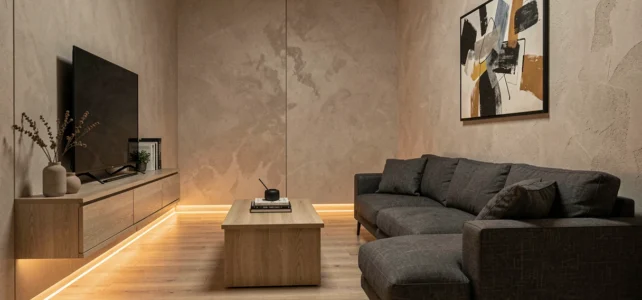
- LED strip behind the television, which reduces the contrast between the bright screen and the dark wall, decreasing eye strain in the evening.
- LED band under the TV unit or under a low buffet, creating a discreet floating effect that highlights the lines of the furniture.
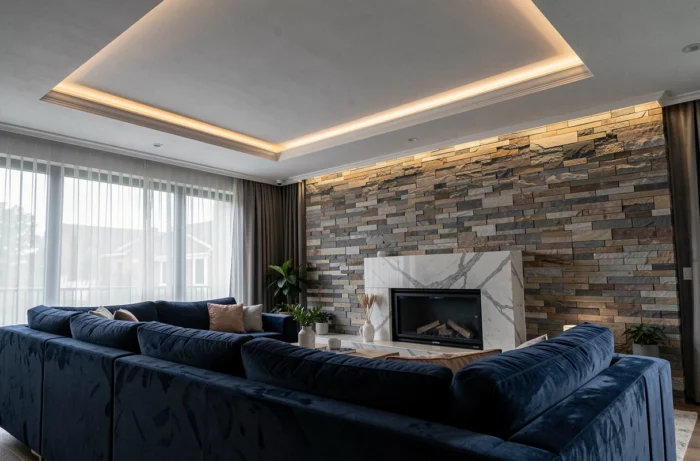
- LEDs in a cornice or ceiling trough, the most effective solution for architectural indirect lighting. The light bounces off the ceiling and descends diffused, with no visible source.
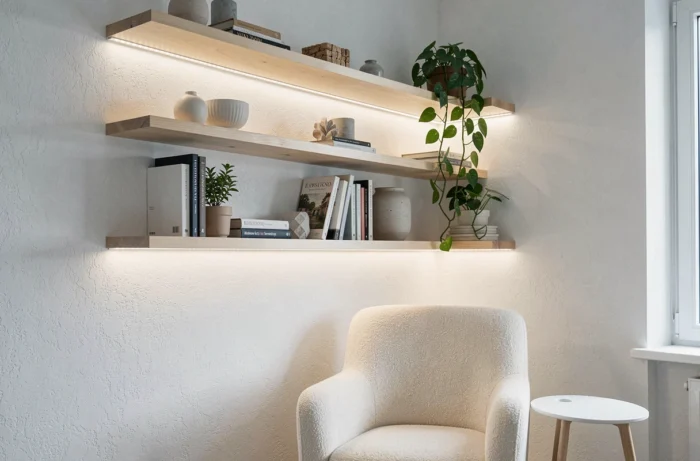
- LEDs integrated into wall niches or open shelves, to highlight decorative objects without visible spotlights.
- LED table lamp on a console or serving table, adding a low and warm light point in a corner that ceiling spots do not reach.
LED Placement Mistakes That Create Flat Lighting
A living room where all the LEDs are on the ceiling produces vertical lighting that flattens the reliefs and removes the natural shadows of the furniture. The faces of seated people appear harsher, and the textures of fabrics disappear.
Multiplying sources at different heights (floor, mid-height, ceiling) recreates a play of shadows and lights closer to natural light. An LED strip on the floor and a sconce at mid-wall are enough to break the monotony of a ceiling fully equipped with spots.
The other common mistake concerns the direction of the flow. Spots directed straight down create bright circles on the floor without illuminating the walls. Slightly tilting the spots towards the walls or decorative elements redistributes the light and visually enlarges the room.
A well-lit LED living room is not just a list of positions. It is the combination of independent circuits, varied heights, and consistent temperatures that produces an ambiance where one willingly stays, without ever feeling like living in a store.