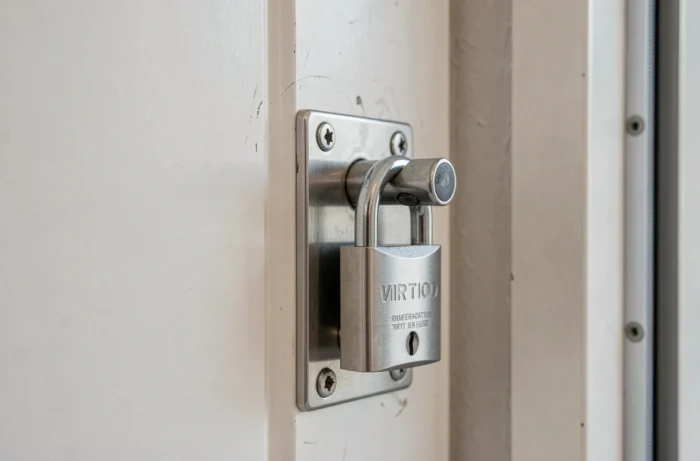
A double locking padlock relies on two axes and two grooves that block the shackle on each side of the body. This architecture distributes the resistance load over two points instead of one, which seriously complicates forcing it with a lever or cutting. Here we detail the installation on secondary access points of a home, where this type of padlock makes perfect sense.
EN 12320 Standard and Resistance Rating of a Double Locking Padlock
No competitor mentions the standard, and that’s a problem. The European standard EN 12320 (2021 version) defines the requirements and testing methods for padlocks. It classifies each model according to its level of resistance to forced entry, from grade 1 (light use) to grade 6 (very high security).
Before purchasing, we recommend checking that the padlock bears the EN 12320 mark on its packaging or technical data sheet. An uncertified double locking padlock guarantees no more than a poorly assembled standard model. The grade also guides the choice of insurer, as some companies require a minimum grade to cover a premises or shelter.
To easily install a double locking padlock, you must first ensure that the chosen model corresponds to the actual mechanical stress level of the targeted access point.
Garage Doors and Garden Sheds: Secondary Access Points to Secure First
Secondary entry points (garage door, garden shed, door leading to a garden) account for about 20% of break-ins. These accesses are often equipped with a simple latch or a low-end padlock with a single shackle, which is easy to cut with a standard bolt cutter.
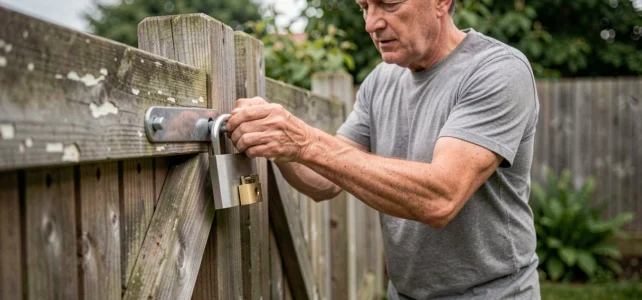
The double locking mechanism blocks the shackle on both sides of the body, which neutralizes the lever technique. On a tilting garage door, the padlock attaches to a hasp (hinged plate) bolted from the inside. On a garden shed, it directly locks both doors via their welded hooks.
We observe that the majority of installations fail not because of the padlock, but because of the support. A hasp screwed with 3.5 mm wood screws into softwood gives way before the padlock. The support must be up to the device.
Criteria for Choosing the Fixing Support
- Hardened steel hasp with through-bolt fixing (minimum diameter 6 mm) rather than wood screws, especially on sandwich panel garage doors.
- Welded or bolted hooks on a plate for double-leaf doors, positioned at mid-height to limit the lever effect on the hinges.
- Anti-lifting protection if the hinges are exposed on the outside, otherwise the padlock protects one side while the other remains vulnerable.
Step-by-Step Installation of a Double Locking Padlock on a Hasp
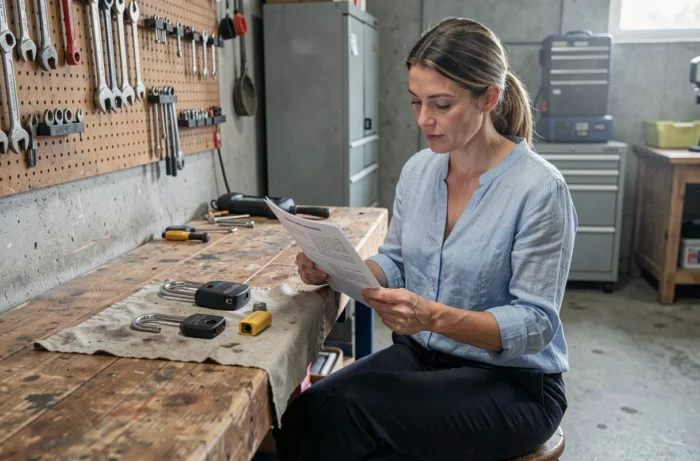
The installation itself is quick if the support is properly prepared. Here is the sequence we apply on a standard hasp fixed to a garage or shed door.
Drilling Preparation
Position the closed hasp against the door and the frame. Mark the fixing holes with a punch. Drill with a 6.5 mm metal drill bit if you are going through a sheet or steel panel. For solid wood (thickness greater than 30 mm), a 7 mm wood drill bit is suitable, followed by through bolts with wide washers and self-locking nuts on the inside.
Fixing and Alignment
Moderately tighten the first fixing, then close the door to check the alignment of the hasp with the hook or strike plate. The padlock’s shackle should enter without forcing into both grooves. If the play is too large, insert a metal shim between the hasp and the surface.
Once the alignment is validated, definitively tighten all fixings. Install the padlock, turn the key, and check that both axes engage simultaneously. If one axis rubs or resists, the hasp is slightly misaligned: loosen, realign, and retighten.
Final Checks
- Test the opening and closing ten consecutive times to detect any gradual alignment defect.
- Apply a dry lubricant (graphite or PTFE) in the cylinder and on the axes. Avoid liquid oil that attracts dust and jams the mechanism within months.
- Check that the bolt heads on the outside are ground down or protected by anti-unscrewing caps to prevent disassembly of the hasp.
Installation Mistakes That Nullify the Padlock’s Resistance
A grade 5 double locking padlock installed on an unsuitable support offers a real resistance equivalent to a grade 2. We identify three recurring mistakes.
The first is the use of short wood screws for fixing. Screws of 20 mm in 10 mm plywood do not hold for thirty seconds against a crowbar. Through bolts with an inner backing plate are the only reliable fixing.
The second is the lack of hinge protection. Locking the lock side without addressing the hinge side is like reinforcing a door while leaving the window open. Anti-lifting pins cost a few euros and can be installed in ten minutes.
The third is direct exposure to the elements without protection. An unprotected outdoor padlock accumulates water in the cylinder. Freezing does the rest. A steel padlock cover or a simple roof overhang above the fixing point extends the lifespan of the mechanism by several years.
The double locking mechanism is not a marketing gimmick. It is a mechanical principle whose effectiveness entirely depends on the quality of the support and the rigor of the installation. A properly bolted hasp, protected hinges, and maintenance with dry lubricant once a year are sufficient to maintain the level of security for which the padlock was designed and tested according to the EN 12320 standard.