The automotive budget weighs heavily on the expenses of French households. Between regular maintenance, unexpected repairs, and the technical inspection, the bill can quickly rise at a traditional garage. The solidarity garage offers a concrete alternative for maintaining and repairing your car at a lower cost, but its operation remains poorly understood and its economic model is sometimes fragile.
Solidarity Garage: Three Levels of Rates for Car Repair
Competitors often mention a vague “reduced rate” without detailing the pricing mechanics. However, solidarity garages that have structured their offerings operate on a grid with three distinct tiers.
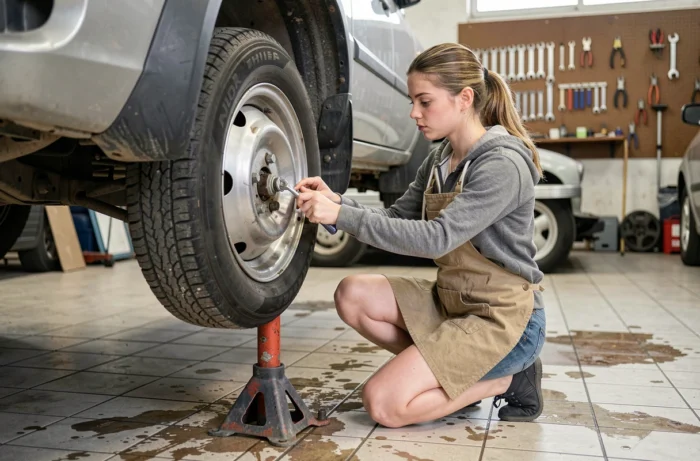
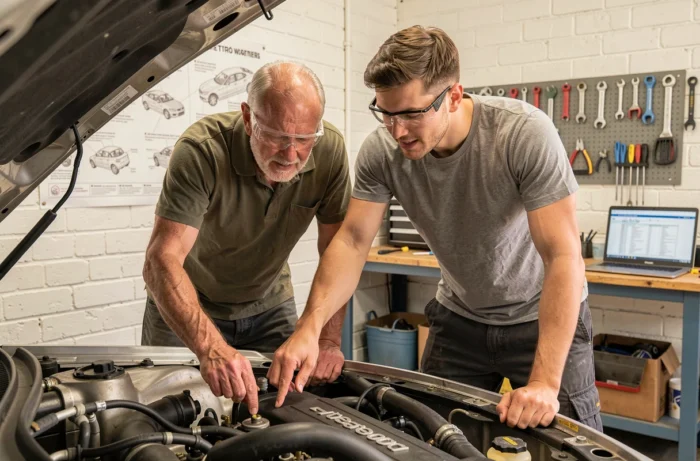
The first level, accompanied self-repair, allows the owner to work on their vehicle with the help of a technical supervisor. The hourly cost ranges between 5 and 15 euros per hour depending on the structure. This format is suitable for simple operations: oil change, brake pad replacement, air filter change.
The second level corresponds to solidarity labor, performed by an employed or in-training mechanic. The rate fluctuates between 30 and 45 euros per hour, compared to rates that are often two to three times higher at a traditional garage. This tier covers more technical interventions (clutch, timing belt, electronic diagnostics).
Some structures add a third tier, a higher “public” rate, open to all without income conditions. The revenue from this segment helps balance the overall economic model. This coexistence of different audiences under one roof allows for the financing of solidarity rates without solely relying on subsidies.
For motorists eligible for reduced rates, it is possible to discover the services of Your Solidarity Garage to estimate the cost of a specific intervention.
Access Conditions and Process to Benefit from a Solidarity Rate
Access to the lowest rates is not automatic. Most solidarity garages require either a family quotient below a certain threshold or a referral from a social worker (social assistant, Pôle emploi advisor, RSA referent). This filtering ensures that the available spots benefit those in real financial difficulty.
The typical process begins with a contact, often by phone. A first diagnosis of the vehicle is made, followed by a detailed quote. The spare parts used are often checked second-hand parts or reused parts, which further reduces the final bill.
- A proof of income or a CAF certificate is generally required to access the solidarity rate
- The prescription from a social worker sometimes replaces the family quotient criterion, depending on the structure
- Waiting times can reach several weeks, as demand often exceeds capacity
This last constraint deserves attention. A report from France 3 Hauts-de-France highlights an unexpected “enthusiasm” during the opening of a solidarity garage in Oise, with a queue forming within the first weeks. Demand regularly exceeds available supply, raising questions about the sizing of these structures.
Economic Fragility of Solidarity Garages: Closures and Model Limits
Online content presents the solidarity garage as a virtuous solution but overlooks the financial difficulties faced by some structures. The case of Solidarauto in Rouen illustrates this fragility: the association underwent judicial liquidation in 2026, leaving the Rouen metropolitan area without a solidarity garage.
The reasons for these closures are multiple. The model relies on a delicate balance between public subsidies, rates charged, and volume of interventions. When a community reduces its financial support or when a location becomes too expensive, the structure can quickly fall into the red.
What the Closure of Solidarauto Rouen Reveals
Paris-Normandie documented this closure and the direct consequences for users. Beneficiaries found themselves without a local alternative at a reduced rate, forced to postpone repairs or go into debt to pay for a traditional garage. The disappearance of a solidarity garage creates a gap in the social mobility network, which is difficult to fill in the short term.
Field feedback varies on this point: some solidarity garages manage to sustain their activity thanks to the “public” tier and stable partnerships with communities. Others, too dependent on a single funder, remain vulnerable. The available data does not allow for a conclusion on an average survival rate of these structures at the national level.
Car Maintenance in a Solidarity Garage: What is Covered and What is Not
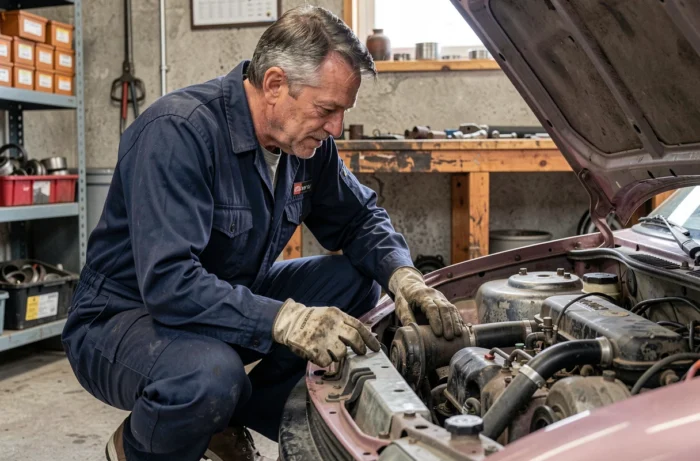
A solidarity garage is not a miniature traditional garage. The scope of intervention is defined and limited. Routine maintenance services are generally well covered:
- Engine oil change and oil filter replacement
- Tire changes, balancing, brake pad and disc replacement
- Battery, spark plugs, belts, air and fuel filter checks
- Heavier interventions like clutch or timing belt, depending on the garage’s equipment
Bodywork is excluded or limited to minor touch-ups. This restriction aligns with the purpose of these structures: to keep a vehicle in working condition, not to restore it aesthetically to new.
Electronic diagnostics vary from garage to garage. The best-equipped structures have diagnostic tools, but this is not systematic. For a complex electronic failure, a solidarity garage may refer the beneficiary to a specialized professional, sometimes at a negotiated rate.
Spare Parts: The Lever of Reuse
A significant portion of the savings achieved in a solidarity garage comes from reused parts. Engines, gearboxes, alternators, starters: these components from end-of-life vehicles are tested before installation. The reuse of parts reduces the bill while limiting waste, a double benefit that aligns with the circular economy logic promoted by the social and solidarity economy sector.
The solidarity garage occupies a unique place in the French automotive landscape. It meets a real need for low-income households, but its sustainability depends on often precarious funding. Before postponing a repair due to budget constraints, checking for the existence of a local structure remains the first reflex to have.