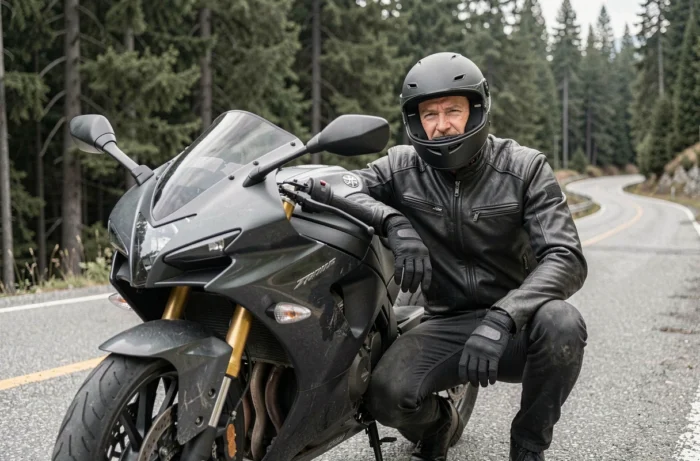
The A2 license limits power to 35 kW for two years. The real technical question concerns the choice of the restriction kit and its impact on engine mapping. A poorly calibrated restriction alters the torque curve to the point of making certain models difficult to accelerate at low revs.
We recommend checking that the restriction approved by the manufacturer maintains a coherent usage range, particularly between 3,000 and 5,000 rpm, an area where most urban acceleration phases occur.
A2 Restriction and Engine Mapping: What Really Changes Under the Tank
A manufacturer restriction is not just a mechanical part inserted into the intake or exhaust. On recent models, it includes a reprogramming of the ECU that adapts injection, ignition, and sometimes shifter management. This software coherence preserves the engine’s flexibility.
Approved aftermarket kits, on the other hand, sometimes only provide a physical restriction without touching the mapping. The result: an engine that “stumbles” against its limitation rather than integrating it. On an inline twin, the difference is clearly felt during acceleration in fourth and fifth gears.
We observe that several riders sell their restricted machine after a few months, not because of the limited power, but due to a degraded riding experience caused by an unsuitable restriction. Before any purchase, consulting the Expert Auto Moto website for motorcycles allows for cross-referencing test feedback on models specifically evaluated in restricted configuration.

ECE 22.06 Helmet Approval: Distinguishing Sales Obligation and Legal Use
Since January 2024, only new helmets approved ECE 22.06 can be sold in France. An ECE 22.05 helmet already in circulation remains perfectly legal to wear. This distinction between sale and use is often misinterpreted, including by some in-store sellers.
The ECE 22.06 standard raises the level of requirements on several points: rotational impact tests, expanded protection area, and better consideration of oblique impacts. For a rider who rides daily, switching to a 22.06 helmet during the natural renewal (approximately every five years) constitutes a measurable gain in protection.
Meanwhile, mandatory equipment in France remains limited to approved helmets and CE-certified gloves for both the rider and the passenger. The high-visibility vest must be on board the vehicle but is only worn in case of an emergency stop. Jacket, boots, and back protectors are recommended but not legally required.
Helmet and Budget: Balancing Versatility and Specialization
An ECE 22.06 modular helmet costs significantly more than an entry-level full-face helmet under the same standard. However, the modular offers a real practical advantage for short urban trips combined with road riding. The compromise is not always relevant for exclusively road use, where the full-face remains lighter and quieter at stabilized speeds.
Autonomous Motorcycle Airbag: A Game-Changing Technology in Back Protection
Autonomous airbag vests no longer depend on a cable connected to the motorcycle. The systems now include inertial sensors (accelerometer, gyroscope) capable of detecting a fall and triggering inflation in a few milliseconds, without any physical connection to the chassis.
This autonomy changes the equipment logic. The same airbag vest can be worn on multiple machines, from scooters to trails, without adaptation. The most advanced models integrate D3O or equivalent back protection, making the wearing of a separate back protector redundant.
- The autonomous triggering relies on an algorithm that analyzes the rider’s trajectory in real-time, which reduces false positives compared to earlier cable models.
- The battery life varies by manufacturer, but most cover several dozen hours of riding before needing a recharge, which is more than sufficient for weekly use.
- The cost of replacing the gas cartridge after deployment remains a budget item to consider annually, often overlooked at the time of purchase.
This type of equipment likely represents the most significant advancement in passive safety since the widespread adoption of back protectors. An autonomous airbag vest protects the chest, back, and neck with a level of shock attenuation that neither a reinforced jacket nor a rigid back protector can match alone.

Electric Motorcycle Market in France: Confirmed Recovery but Still a Narrow Segment
After a period of decline, the French electric two-wheeler market experienced a rebound in the first half of 2026, with a recovery particularly visible in June. This dynamic is more pronounced in the urban scooter segment than in the touring motorcycle segment, where range remains a structural barrier.
The electric models available in the equivalent of 125 cc find their audience among commutes of less than forty kilometers. Beyond that, the issue of fast charging infrastructure arises with an urgency that thermal vehicles do not face.
Electric Motorcycle Insurance and Young Driver Profile
Insurance for an electric motorcycle as a young driver does not automatically benefit from a reduced rate despite theoretically lower claims. Insurers factor in the cost of battery replacement in their risk assessment, which largely offsets any potential ecological bonus. Comparing offers based on the actual driving profile (annual mileage, parking, mixed or exclusively urban use) remains the only reliable method to optimize the premium.
The motorcycle market is evolving on several simultaneous fronts: equipment regulation, gradual electrification, active protection technologies. Keeping track of these changes requires cross-referencing technical sources rather than relying on general guides that smooth over nuances. The next regulatory deadline to watch concerns the possible extension of equipment obligations beyond helmets and gloves, a topic that regularly resurfaces in European discussions without yet reaching a conclusion.