
Creating family meals that are quick, balanced, and accepted by all ages presents a precise nutritional equation. The plate distribution, actual preparation time, and the degree of processing of the ingredients are three measurable variables. This article compares them to identify easy and balanced recipes that deliver on their promises every day.
Actual preparation time by type of family dish
Recipe websites often announce flattering durations. The displayed time does not always account for peeling, passive cooking, or plating. Comparing families of dishes based on a single criterion, the total time from opening the refrigerator to the plate on the table, provides a more reliable overview.
| Type of dish | Estimated total time | Active preparation | Suitable for weeknights |
|---|---|---|---|
| Pasta with sautéed vegetables | 20 min | 10 min | Yes |
| Vegetable and starch gratin | 40-45 min | 15 min | Yes (passive cooking) |
| Protein-rich mixed salad | 15 min | 15 min | Yes |
| Fish in parchment and rice | 30 min | 10 min | Yes |
| Homemade quiche (including crust) | 50-60 min | 20 min | More suitable for weekends |
Dishes with passive cooking (gratin, parchment) free up time for helping with homework or setting the table. In contrast, a quiche with homemade crust easily exceeds 50 minutes, making it more suitable for the weekend.
Among the resources that structure these meals around simplicity, easy recipes with Myn Idee on 3 Coups 2 Fourchette offer ideas designed for family daily life.

Balanced plate distribution: vegetables, proteins, and starches
The commonly recommended structure is based on a simple principle: half the plate with vegetables, a quarter with proteins, a quarter with whole starches. This ratio adapts to most family recipes without requiring calculation.
Applying this ratio to everyday recipes
A zucchini and potato gratin with grated cheese seems balanced. It is less so when the potatoes take up three-quarters of the dish and the zucchinis serve as decoration. The same reasoning applies to pasta: a dish of macaroni with ham without vegetables remains an incomplete meal.
Some concrete adjustments change the game:
- Add a handful of fresh spinach or cherry tomatoes to the salmon pasta to rebalance the vegetable portion without altering the recipe
- Replace half of the potatoes in a gratin with broccoli or cauliflower, which reduces caloric density while maintaining the creamy aspect
- Always serve a green salad alongside quiches and savory tarts, rather than relying on the vegetables integrated into the filling
A quick family dish becomes balanced as soon as the vegetables visually occupy half the plate. This visual rule works better than any gram counting in daily life.
Ultra-processed products in family meals: what the regulations say
The majority of culinary content encourages cooking “homemade” to avoid ultra-processed products. This recommendation is based on a real scientific foundation, but nuanced. Anses published an opinion in January 2025 on ultra-processed foods (NOVA classification). Its conclusion: high consumption of foods from group 4 (ultra-processed) is associated with a higher risk of mortality and chronic diseases.
The nuance lies in the level of evidence, described as “low” by Anses, which also emphasizes the lack of a consensual definition of ultra-processing. This point changes the perspective: demonizing an industrial chicken nugget while considering a jarred pesto as “healthy” has no clear regulatory basis.
No mandatory labeling of the degree of processing in France
As of 2026, there is no obligation for labeling the degree of processing in France or the EU. Regulation (EU) No. 1169/2011 mandates the ingredient list, allergens, and nutritional declaration, but not the NOVA classification. In practical terms, a parent wanting to avoid ultra-processed products must read the ingredient list and identify additives, emulsifiers, and artificial flavors themselves.
This means that “from scratch” family recipes retain a structural advantage: when starting with raw vegetables, unprocessed proteins, and simple starches, the question of the degree of processing no longer arises.
Five balanced family recipes categorized by season
Rather than listing recipes without context, this classification associates each dish with the season when its ingredients are most accessible and least expensive.
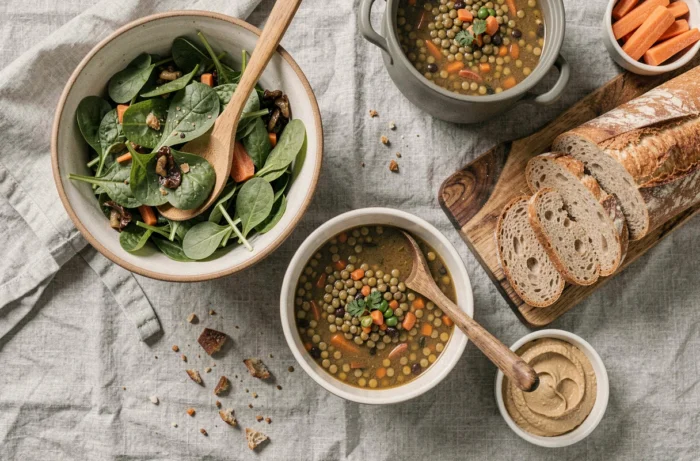
- Autumn-winter: butternut squash gratin, roasted chicken, and green lentils. The butternut cooks in 25 minutes in the oven, and lentils do not need soaking
- Autumn-winter: leek-potato soup served with melted cheese toast. Active time under 15 minutes
- Spring-summer: whole grain pasta salad with tomatoes, cucumber, feta, and cold chicken. No cooking except for the pasta
- Spring-summer: salmon parchment with zucchini and lemon, served with basmati rice. The whole meal takes 30 minutes
- All season: vegetable omelet (mushrooms, peppers, spinach) with a slice of whole grain bread
The seasonal logic reduces the cost of vegetables and improves their taste, making them easier for children to accept. A seasonal, firm, and sweet broccoli does not taste the same as an out-of-season imported broccoli.
The absence of labeling for the degree of processing makes the choice of raw ingredients even more relevant. Starting with identifiable products, a whole vegetable, a fillet of fish, a packet of dry pasta, remains the most reliable method for composing balanced family meals without relying on a still vague classification system.