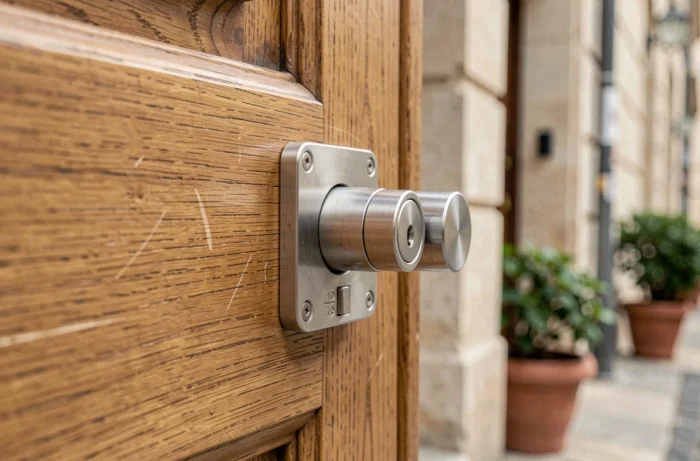
A high-security lock is not just about the number of locking points displayed on the packaging. The actual level of protection depends on the combination of the mechanism, the cylinder, and the strike plate, tested together according to a standardized protocol. Here, we detail the technical criteria that make a difference in practice, far from simplified commercial arguments.
A2P Certification: The Trap of an Unreferenced Cylinder
A2P certification (Assurance Prévention Protection) remains the only reliable reference for assessing the resistance to burglary of a lock in France. It is available in one, two, or three stars depending on the duration of resistance to destructive opening attempts.
A technical point often overlooked: the certification applies to an inseparable set of lock, cylinder, and strike plate from the same manufacturer. Replacing the original cylinder with a third-party model, even one known for its performance, can cause the entire assembly to lose its certification. In the event of a claim, the insurer has the right to refuse compensation if the installed set no longer corresponds to the certified configuration.
We recommend systematically checking that the delivered cylinder bears the same certification number as the lock. Professionals offering security solutions at La Serrurerie Valbusa generally provide complete sets that have already been validated, which avoids this risk of decertification.
Another regulatory clarification to keep in mind: A2P certification is voluntary and is not imposed by any legal text on individuals. The obligation, when it exists, comes from the home insurance contract. Reviewing its specific conditions before choosing a model helps avoid either insufficient or oversized investment.
Multi-Point Lock and Door Block: Two Distinct Certifications
Consumer articles often confuse the certification of the lock and that of the door block. These are two separate references.
- The A2P certification of the lock (one to three stars) assesses the resistance of the locking mechanism to burglary: picking, drilling, cylinder pulling, forcing on the bolts.
- The certification of the door block (A2P BP standard, with its own levels) tests the entire door, frame, hinges, lock, and any glazing against complete intrusion scenarios.
- Installing a three-star lock on a thin panel door or a poorly fixed frame significantly reduces the actual security gain, as the burglary will bypass the strong point to attack the weak point.
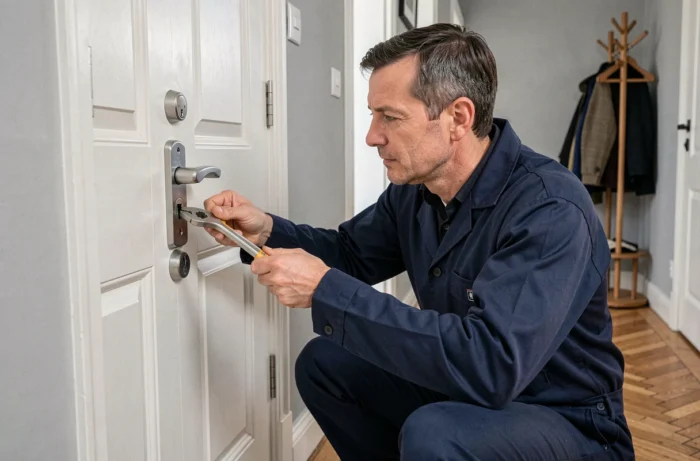
Before any lock replacement, a support diagnosis is necessary. If the door itself cannot withstand a crowbar applied at the strike plate level, investing in a high-end cylinder is akin to putting a padlock on a cardboard box.
Connected Locks and A2P@ Certification: Beyond Comfort
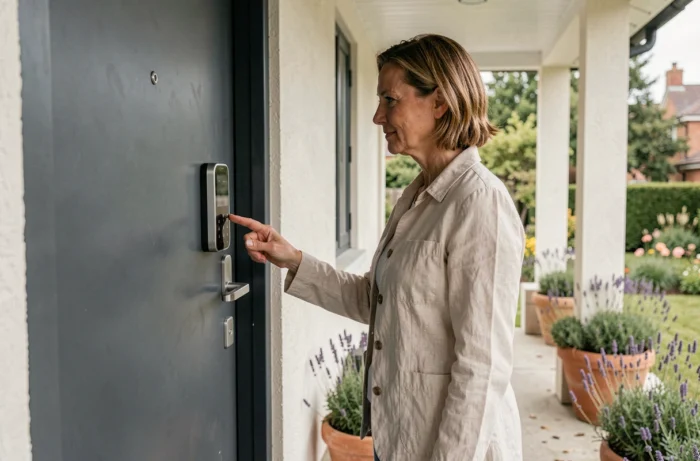
Connected locks have multiplied in recent years, driven by home automation and remote control. Most consumer models offer user comfort (smartphone opening, management of temporary access) without guaranteeing resistance to burglary.
A2P@ certification specifically evaluates robustness against digital attacks in addition to mechanical tests. It checks the resistance of the communication protocol (encryption, protection against relay attacks, firmware integrity). A model simply labeled “smart” or “connected” without this certification does not protect against digital intrusion techniques.
We observe that the majority of connected locks sold in supermarkets do not have this certification. The additional cost of a certified A2P@ model is justified when the lock constitutes the main access point of the home and not just a simple addition on a secondary door.
Selection Criteria for a Reliable Connected Lock
The communication protocol must use end-to-end encryption. Models that operate solely on Bluetooth Low Energy limit the risk of remote interception but restrict control to the immediate perimeter. Wi-Fi or Zigbee models offer remote control but expose a larger attack surface.
Prioritizing a model whose mechanical cylinder remains functional in case of electronic failure ensures emergency access. A connected lock without a physical backup key becomes a vulnerability if the battery is dead or the radio module fails.
Cylinder Resistance: Attacks to Know
The cylinder concentrates almost all rapid burglary techniques. A hurried burglar does not target the bolt but the cylinder, as it is the most exposed component on the outside.
- Bumping exploits a special key struck to align the pins by inertia. High-security cylinders incorporate anti-bump pins with an asymmetric profile.
- Picking uses fine tools to manipulate the pins one by one. Cylinders with paracentric pins or rotating discs complicate this technique.
- Drilling aims to destroy the rotor. Certified cylinders include hardened steel or tungsten carbide pins to resist the drill bit.
- Pulling with pliers or extractor targets the cylinder protruding from the door panel. A cylinder guard (security rosette) reduces the mechanical grip and limits this risk.
A cylinder lacking protection against at least these four attack vectors does not deserve the label “high security,” regardless of its price.
High-Security Lock: What the Insurer Really Checks
In the event of a burglary, the expert appointed by the insurer examines the lock in place, not the purchase invoice. They check for the presence of A2P marking on the cylinder and the housing, the compliance of the installation with the certified configuration, and the absence of subsequent modifications (cylinder change, addition of an incompatible cylinder guard).
If the contract requires a certified lock and the installed set does not correspond, the warranty forfeiture clause may apply. Keeping the cylinder ownership card and the installation invoice from a qualified professional constitutes the best administrative protection in addition to mechanical protection.
The choice of a high-security lock hinges on the coherence between the cylinder, the mechanism, the door, and the contractual requirements of the insurance. An isolated component, no matter how effective, does not compensate for a weakness elsewhere in the chain.